Allicin International
Tuesday, 07 September 2010
The Heart of Garlic
Did you know?
"One must be very suspicious of anyone who does not eat garlic"
- Roman Proverb

Main Menu
Home
About Us
What is Allicin?
Published articles
Product Range
Contact us
Site administration
External Links
Shop
Latest news
 
An overview of Allisure Powder
Stabilised allicin has been successfully incorporated into over 40 products worldwide. The guarantee that real stabilised allicin powder has been used in a product is the registered trademark ALLISURE. Always read the label of products you purchase and if Allisure is mentioned as an ingredient then this is your guarantee that real stabilised allicin has been used in that product.

Allisure™
The Ultimate Garlic Supplement


Garlic (Allium sativum) has been used as a medicine and health-promoter for 5,000 years. It was widely used in ancient Assyria, Egypt, India, Greece and China.1 Garlic was used in medieval and Renaissance Europe to treat poisons, bites, edema, ulcers, toothaches, plague and smallpox.1 Albert Schweitzer used garlic in Africa to cure cholera and typhoid in the early 20th century.1 Garlic was widely used in Europe, especially England, to treat war wounds and dysentery during World War I.1 In modern Europe and the U.S. garlic supplements are widely used. There were at least 1,200 pharmacologic studies done on garlic by mid-1997, as well as many hundreds of studies on the chemistry of garlic.1

The chemistry of garlic is extremely complex, but research has shown that it is the unusual organosulfur compounds relatively unique to garlic that promote its broad range of lipid-lowering, antithrombotic, anti-blood coagulation, anti-hypertension, anticancer, antioxidant, and antimicrobial effects.1 The most well-known and widely studied garlic compound is allicin, yet ironically allicin does not exist in fresh, undamaged garlic cloves.1 The predominant garlic sulfur compound is alliin.1 Garlic also contains high levels of an enzyme called “allinase.”1

When fresh garlic cloves are crushed or chopped, or garlic powder that has been carefully dried to preserve its alliin/allinase content is added to water, allicin is produced in seconds by the action of allinase on alliin.1 Allicin and other thiosulfinates are somewhat unstable, but dilution and dissolving in water “greatly improve their stability.”1 Allicin can decompose into a broad range of compounds, including S-allylmercaptocysteine, allylmercaptan, diallyl disulfide, allylmethyl disulfide, vinyldithiins, ajoene, and possibly allylsulfinic and allylsulfonic acid.1

Cavallito and Bailey first reported in 1944 that allicin is the garlic compound chiefly responsible for the broad-spectrum antibacterial action of garlic.2 Lawson has noted that various actions of garlic, such as its cholesterol-lowering and antibacterial effect, are primarily due to its allicin content, since removal of alliin from garlic, or inactivation of allinase by microwave cooking, eliminates these effects, while adding allicin back into garlic powders so treated restores such garlic’s anticholesterol/antibacterial activity.1

Allicin is apparently well-absorbed. An animal study with radioactive-labeled allicin showed 79 percent absorption within 30-60 minutes after oral intake, with 65 percent excretion of radioactive allicin metabolites within 72 hours.1 Four animal and five human studies have shown that orally consumed crushed garlic and allicin-related compounds have systemic antimicrobial effects in the lungs, kidney, brain, blood and cerebrospinal fluid, further showing absorption and activity of allicin and its metabolites.1

Allicin: The Gold Standard of Garlic
Because of the centrality of allicin and its metabolites to the health benefits of garlic, many garlic supplements are standardized to yield a certain “allicin potential,” for example, “allicin potential: 10,000 ppm.”

When garlic cloves are properly prepared and dried, the alliin and allinase activity of fresh whole garlic are preserved. When such dried garlic powder is added to water, the alliin and allinase quickly react and allicin is produced. This is how “allicin potential” is measured.3 However, the situation is completely different when such garlic supplements are swallowed. Allinase enzyme is rapidly and completely destroyed by stomach acid.3

Many garlic supplements are coated with a special coating that protects the garlic from stomach acid, but dissolves in the alkaline conditions of the small intestine, where the allicin should then theoretically be produced. Unfortunately such supplements usually don’t work as designed. Lawson and Wang reported the results of testing 23 coated, U.S. garlic supplements in 2001.3 Twenty of 23 failed to release even 15 percent of their claimed “allicin potential” when placed in simulated intestinal fluid. Lawson and Wang concluded that allicin potential is an extremely poor measure of garlic supplement activity in the human body.

Allisure: True Allicin Garlic Extract
Peter Josling, Norman Bennett and collaborators have recently come up with a completely new, patented approach to producing a garlic supplement containing real, preformed allicin. This approach makes tablet coatings and carefully controlled tablet dissolvability irrelevant.

According to Josling, Allisure™ is produced through a carefully temperature/pressure-controlled process, using water to continually flush allicin from the reaction vessel as soon as it’s formed. This yields a dilute water solution of allicin, which is further diluted and freeze-dried onto a maltodextrin-matrix to produce stabilised allicin powder.

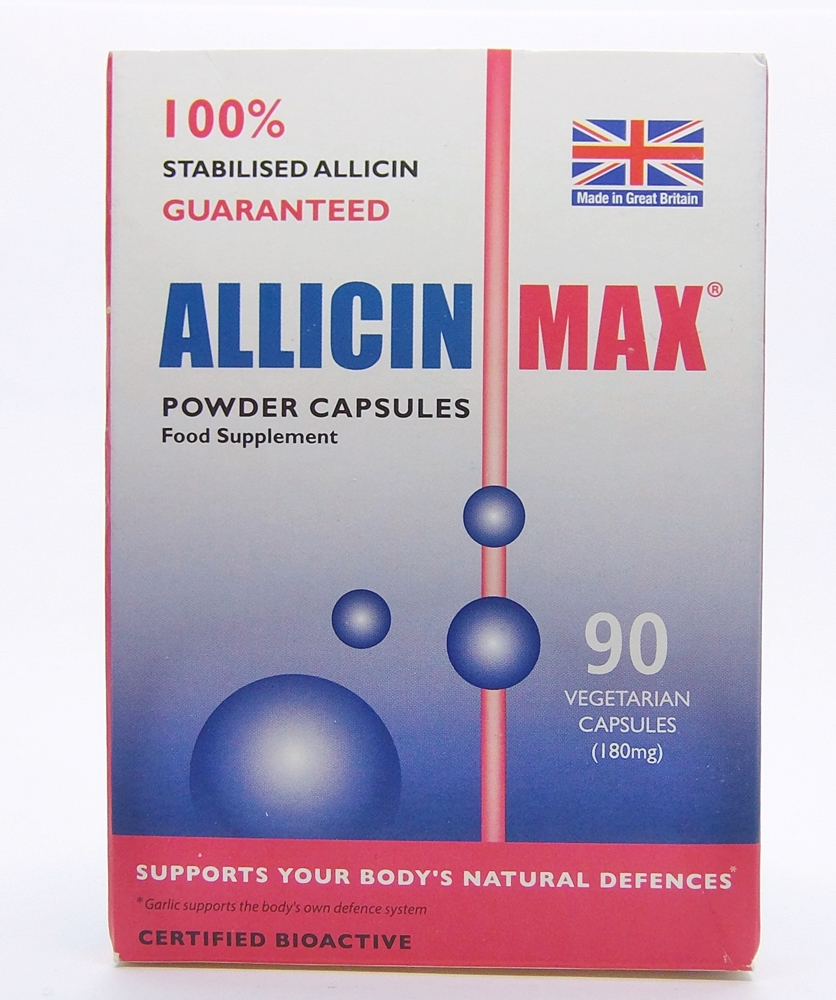
The diluting and dissolving in water, as well as spray drying onto a slightly acid powder, stabilizes the allicin, even without refrigeration.1,4 Allisure is available in 180 mg capsules, which provide 55-60 mcg allicin/cap as well as a powder, which provides approximately 300 mcg allicin per gram.

The Benefits of Allicin
In his comprehensive 1998 review of garlic and its medicinal compounds (with 207 references), Lawson provides a “summary of the main compounds essential to the pharmacological effects of garlic cloves at normal levels of consumption.”1

Allicin is the chief thiosulfinate (about 75 percent of total) formed when fresh raw garlic is crushed, chopped or chewed.1 Lawson reports there is “good evidence” that allicin and possibly other thiosulfinates are the main compounds essential to garlic’s antimicrobial, lipid-lowering, antithrombotic, fibrinolytic, antioxidant, anticancer and pro-immune effects.1 He notes: “This does not mean that all of the effects of garlic are due solely to the thiosulfinates, but no other compound has yet been identified with significant activity at levels present in whole or crushed garlic.”1

Allisure: Possible Contraindications
Allicin at high concentrations has been reported to be a potentially toxic substance.8 The LD50 (lethal dose for 50 percent of test subjects) for mice is 309 mg (309,000 mcg)/kg of body weight for male mice, 369 mg (369,000 mcg)/kg of body weight for female mice.8

Assuming humans have roughly the same sensitivity to allicin as mice, a 70 kg (154 pound) person would have to ingest at least 21,630 mg (21,630,000 mcg) of pure allicin to have a 50 percent chance of dying. It would take approximately 360,000 capsules of Allisure to yield that much pure allicin. Allicin at high concentrations might damage the intestinal lining,8 yet Ankri and Mirelman note that no damage was seen to cultured mammalian cells at high concentrations of allicin (100 micromoles, or 162 mcg/ml) if there were unfriendly microbes for the allicin to attack, “suggesting that the affinity of the allicin molecules is towards the parasite targets.”5 Since we all have intestines filled with trillions of unfriendly microbes, allicin will have plenty to attack other than our intestinal linings.

A Chinese study found consumption of 20 grams daily of raw garlic reduced stomach cancer incidence 92 percent, while an American study found three or more servings of garlic weekly reduced pre-cancerous colorectal polyps 37 percent, clear indications that allicin at real-world doses is not harmful to the gastrointestinal tract.1

The main thing to watch for with garlic or allicin supplements is an allergy to garlic/allicin. Such allergies will usually trigger a tell-tale rash which goes away upon discontinuing garlic/allicin.10

Allisure: The Garlic Revolution
Allisure represents the first major breakthrough in delivering the health benefits of garlic in decades. It is the only product that can guarantee the delivery of pre-formed allicin to the body.

And as Larry Lawson, one of the world’s premier experts on garlic has noted, it is primarily allicin and its metabolites that account for most of the amazing health benefits of garlic that have been discovered during 5,000 years of garlic use.1 Allisure is effective when taken orally or used topically. Allisure has a mild garlic taste, and can be sprinkled on food like garlic powder, yet produces little or no garlic odor, unlike cooked or raw garlic.

References
1. Lawson, L.D. “Garlic: A review of its medicinal effects and indicated active compounds” In: Lawson, L.D., Bauer, R., eds. Phytomedicines of Europe: Chemistry and Biological Activity. Amer. Chem. Soc. Symposium Series 691. Washington D.C.: Amer Chem Soc; 1998: 176-209.
2. Cavallito, C. & Bailey, J. “Allicin, the antibacterial principle of Allium sativum. Isolation, physical properties and antibacterial action” J Am Chem Soc 66 (1944): 1944-52.
3. Lawson, L. & Wang, Z. “Low allicin release from garlic supplements: a major problem due to the sensitivities of allinase activity” J Agric Food Chem 49 (2001): 2592-99.
4. O’Gara, E. et al “Activities of garlic oil, garlic powder, and their diallyl constituents against Helicobacter pylori” Appl Environ Microbiol 66 (2000): 2269-73.
5. Ankri, S. & Mirelman, D. “Antimicrobial properties of allicin from garlic” Microbes Infect 2 (1999): 125-29.
6. Josling, P. “Preventing the common cold with a garlic supplement: a double-blind, placebo-controlled survey” Adv Nat Ther 18 (2001): 189-93.
7. Josling, P. Allicin – The Heart of Garlic. Callahan, FL: NWI Pub.; 2004: 111-20.
8. Amagase, H. et al “Intake of garlic and its bioactive components” J Nutr 131 (2001): 955s-62s.
9. Sivam, G. “Protection against Helicobacter pylori and other bacterial infections by garlic” J Nutr 131 (2001): 1106s-08s.
10. Allicin – The Heart of Garlic op. cit., 30.

Allicin International